Assignment:
Advanced Pharmacology Professional Practice Case Reviews

WE WRITE PAPERS FOR STUDENTS
Tell us about your assignment and we will find the best writer for your project.
Write My Essay For MeCreate presentation focusing on all medications presented during the Focused Exams in ShadowHealth©, and consider an alternative for each condition.
Review the following ShadowHealth© Focused Exams assignments:
UTI with Antibiotic Sensitivity
Community Acquired Pneumonia
COPD
Hypertension and Type 2 Diabetes
| PLACE YOUR ORDER NOW AT writtask.com |
Pain management
Discuss the medications prescribed during each ShadowHealth© Focused Exam and an alternative for each medication in the case studies. After each case study, you will describe evidenced based practice guidelines for each condition and will briefly share your findings. Your presentation should include:
| PLACE YOUR ORDER NOW AT writtask.com |
Prescribed drug:
Name, drug class, pharmacokinetics, pharmacodynamics, and uses
Diagram mechanism of action in the body
Possible drug interactions and pharmacogeonomic considerations
Monitoring parameters and understanding of success with medication
Possible side effects and patient education
Alternative Drug:
Name, drug class, pharmacokinetics, pharmacodynamics, and uses
Diagram mechanism of action in the body
Possible drug interactions and pharmacogeonomic considerations
Monitoring parameters and understanding of success with medication
Possible side effects and patient education
Locate at least one scholarly article, written within the last 5 years, that discusses the most recent recommendations/guidelines for treatment of each case study and briefly discuss your findings and implications for clinical practice.
This PowerPoint® (Microsoft Office) or Impress® (Open Office) presentation should be a minimum of 22 slides, including a title, introduction, conclusion and reference slide, with detailed speaker notes and recorded audio comments for all content slides. Review and use at least four scholarly sources to support your perspective and make certain to review the module’s rubric before starting your presentation. Review and use at least four (4) scholarly sources and graphics, diagrams, and/or illustrations to support your perspective and make certain to review the module’s rubric before starting your presentation.
Assignment Expectations-
Length: Minimum 20 slides; answers must thoroughly address the questions in a clear, concise manner
Structure:
Title slide (1 slide)
UTI (3-4 slides)
Community Acquired Pneumonia (3-4 slides)
COPD (3-4 slides)
Hypertension (3-4 slides)
Type 2 Diabetes Mellitus (3-4 slides)
Pain management (3-4 slides)
References (1 slide)
| PLACE YOUR ORDER NOW AT writtask.com |
Additionally, because a good presentation has speaker notes, include speaker notes on each slide with the verbiage you would say when presenting; speaker notes should be a minimum of 50 words per slide.
References: Use the appropriate APA style in-text citations and references for all resources utilized to answer the questions. Include a minimum of four (4) scholarly sources to support your claims.
Format: Save your assignments PowerPoint® (Microsoft Office) or Impress® (Open Office) presentation
File name: Name your saved file according to your first initial, last name, and the module number (for example, “RHall Module1.pptx”)
| PLACE YOUR ORDER NOW AT writtask.com |
M8 Assignment UMBO – 2, 4, 5
M8 Assignment PLG – 1, 4, 5, 8, 9
M8 Assignment CLO – 1, 2, 3, 5, 6, 7
Total Point Value of Assignment: 400 points
dear writer there are some of the previos papers..
UTI
Nursing training provides an opportunity for nurses to equip themselves with the necessary skills for future practice. There are notable teaching approaches that help to shape the clinical experiences of nurses as they leave nursing training. One such opportunity is the shadow health assessment that allows the students to perfect their nursing competency. Through digitally standardized patients, the students have an opportunity to do an assessment and institute proper healthcare intervention measures as will be demonstrated for UTI with antibiotic sensitivity (Makayla Henderson).
Whether to Prescribe Medication
From the patient analysis, the most feasible medical prescription is to use 100mg of Nitrofurantoin. The patient should take one oral tablet after every twelve hours for the next five days. Taking this medication helps the patient’s body to quickly filter out the infectious microorganism out of the blood through the urine. This is important because the assumption is that the urine is concentrated around tract and the drug increases the peeing rate hence draining away the infection (Muller et al.,2017). Furthermore, the drug interferes with the production of bacterial proteins, the cell walls and the DNA.
Second Line Therapy
According to IDSA guidelines, the most appropriate second-line treatment for UTI is the use of beta-lactam agents like cefdinir. Cefdinir, a cephalosporin antibiotic, is often administered as 300 mg twice a day for 5 to 7 days and is key in stopping the growth of bacteria. The patient takes the drug orally either before or after meal.
Parameters for Monitoring Success of the Therapy
There are notable parameters for monitoring the success of the therapy. The first parameter is safety of the medication. If the patient doesn’t display significant side effects after receiving the medication, then it can be argued that the therapy was successful. The second parameter is the level of infections in the system as displayed by the color of the excreted urine.
Patient Education Based on the Prescribed Therapy
Patient education is an important step towards ensuring the efficiency of the drug intervention. The first thing to inform the patient is the potential lung or liver issues after the therapy session. As such, it is advisable that Nitrofurantoin is not taken for long-term therapy. In case of symptoms related to liver or lung infection, it is important to consult a physician as soon as possible. Another issue is diarrhea as the drug can result in mild or severe diarrhea. When there is diarrhea while taking the drug, dehydration may be in the offing which necessitates timely intervention (American Academy of Paediatrics, 2020).
Adverse Reactions for The Selected Agent
There are adverse reactions when a person takes Nitrofurantoin due to UTI. The first side effect is nausea or vomiting, dark urine and the loss of appetite while others may experience shortness of breath and fever (Dasgupta, Brymer & Elsayed, 2017). Besides, Nitrofurantoin is also associated with loss of appetite and a damage to the nerves that result in numbness and weakness of the body muscles.
Recommended Lifestyle Changes
For a patient with UTI, the best lifestyle change is to take a lot of water and other fluids. The water will help to flush away the bacteria and the antibiotics out of the system. When feeling the urge to take a short call, it is also important to do so as soon as possible.
Drug-Drug or Drug-Food Interactions
The described therapy should not be taken simultaneously as they may interact and cause harmful effects. One such effect is seizure disorders and other instabilities. In terms of food interactions, Nitrofurantoin should not be taken together with antacids or mineral supplements that may have aluminum, magnesium or Iron. These foods make it harder for the body to absorb the medications.
Conclusion
The use of a digital simulation program is important in shaping the competency of nurses towards healthcare practice. The shadow health assessment gives an opportunity for students to shape their clinical practice experience. This task has presented how the simulation activity can help to improve the competency level of nurses towards management of UTI.
References
American Academy of Pediatrics. (2020). Early Behavioral Intervention in Preventing UTI. AAP Grand Rounds, 44(1), 11-11. DOI: https://doi.org/10.1542/gr.44-1-11
Dasgupta, M., Brymer, C., & Elsayed, S. (2017). Treatment of asymptomatic UTI in older delirious medical in-patients: a prospective cohort study. Archives of Gerontology And Geriatrics, 72, 127-134. https://doi.org/10.1016/j.archger.2017.05.010
Muller, A. E., Verhaegh, E. M., Harbarth, S., Mouton, J. W., & Huttner, A. (2017). Nitrofurantoin\’s efficacy and safety as prophylaxis for urinary tract infections: a systematic review of the literature and meta-analysis of controlled trials. Clinical Microbiology and Infection, 23(6), 355-362. https://doi.org/10.1016/j.cmi.2016.08.003
Pain management
Pain Management
Shadow health assessments provide an opportunity for nursing students to learn disease diagnosis and in offering the appropriate healthcare interventions. In healthcare intervention, it is appropriate to critically consider both the first and second line of treatment in addressing an impeding healthcare issue. This task critically evaluates pain management in a shadow health assessment.
Whether I Will Describe the Medication
It will be necessary to provide medication to the patient at this stage to help ease the pain the patient is experiencing. For the mild and acute pain that the patient is experiencing, the best first line of treatment for the patient is acetaminophen. The most appropriate medication for the acute pain includes naproxen/ Naprosyn. The drug is chosen based on the effectiveness, the adverse effect profile, the cost and the availability since most can be obtained over the counter (Arcangelo et al., 2017). For second line of treatment, the use of opioid analgesics as well as tramadol can be used. However, there is need for an understanding of the pain mechanisms and good communication between physicians and the patients is key in improving the outcomes of patients.
Parameters for Monitoring Success of The Therapy
There are many parameters that can be used to assess the success of the instituted therapy. The first parameter is the pain intensity and the expectations about the time to be used before the patient achieves full recovery. If the intensity of the pain reduces, then the therapy can be regarded to be a success. On the contrary, if the intensity remains high, then the therapy will not be very efficient. The other parameter is the time to achieve complete recovery. After the prescription, the efficiency of the medication is determined by how fast the patient can show initial signs of pain relief (Keefe & Wharrad, 2012).
Patient Education Based on The Prescribed Therapy
Education is an important way through which to help address the healthcare needs of the patient experiencing chronic pain. The education should capture both physiological, psychological and environmental aspects. For instance, it is important to educate patients on the possible side effects of the therapy and how the side effects can be resolved. As the patients receive the therapy, they have to be educated on what they expect such as symptoms and when to seek medical care and the best way to take care of themselves. The patient should also be educated on the need to receive prescriptions after the prescription of a physician and not to only rely on the other over-the counter medications.
Adverse Reactions for The Selected Agent
There are notable side effects when the patient uses acetaminophen. The adverse reactions include nausea, presence of stomach pain, notable itching due to rashes, loss of appetite, persistent headache and clay-colored stools. Although the agent is known to relieve minor aches and pain, it may not reduce swelling and can at times result in inflammation. Besides, Aziznejadroshan et al., (2015) contends that although the agent may not lead to an increase in blood pressure, it is known to cause liver damage.
The Recommended Lifestyle Changes for the Patient
To achieve faster pain relief, the first pain management is spending more time in nature, get a better sleeping pattern, avoiding alcohol and embracing a healthy diet as well as minimize pain
Drug-drug and drug-food interaction
Acetaminophen can interact with other drugs such as warfarin, isoniazid and carbamazepine. People that are allergic to these medications are however not recommended to take it. Those with severe liver disease are also not advisable to use the therapy.
Conclusion
Pain management is a significant concern in healthcare. Chronic pain can increase chances of other healthcare conditions. To ease pain, both the first- and second-line therapy need to be used with a consideration of the success, adverse effects and necessary lifestyle changes as described in this task.
References
Arcangelo, V. P., Peterson, A. M., Wilbur, V., & Reinhold, J. A. (2017). Pharmacotherapeutics for advanced practice: A practical approach (4th ed.).
Aziznejadroshan, P., Alhani, F., & Mohammadi, E. (2015). Challenges and practical solutions for pain management nursing in pediatric wards. Journal of Babol University of Medical Sciences, 17(12), 57-64.
Keefe, G., & Wharrad, H. J. (2012). Using e-learning to enhance nursing students\’ pain management education. Nurse Education Today, 32(8), e66-e72.
Pneumonia
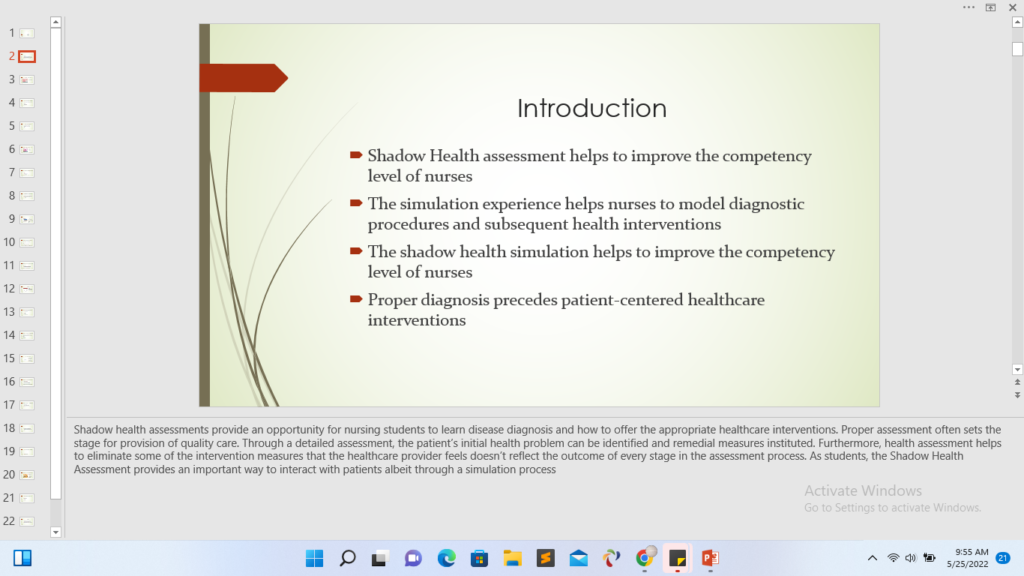
In any healthcare setting, proper assessment often sets the stage for provision of quality care. Through a detailed assessment, the patient’s initial health problem can be identified and remedial measures instituted. Furthermore, health assessment helps to eliminate some of the intervention measures that the healthcare provider feels doesn’t reflect the outcome of every stage in the assessment process. As students, the Shadow Health Assessment provides an important way to interact with patients albeit through a simulation process. During the assessment, students can practice communication skills, documentation, physical assessment using digitally standardized patients (Arcangelo et al., 2017). This task uses the assessment to explore community health pneumonia condition using Anita Douglas as the model patient.
Background of the Condition
The condition is one of the most infectious conditions and is described as pneumonia which one gets when not in a hospital setting or any long-term facility. Often, CAP occurs within 48 hours after a person is admitted or in a patient doesn’t show signs of healthcare-linked pneumonia.
Whether to Describe Medication
Since the patient has used antibiotics, I suggest the use of a respiratory fluoroquinolone such as moxifloxacin or Gemifloxacin. As it stands based on the subjective data, the client has mild and moderate community acquired pneumonia due to notable range of pathogens. As a good remedy for different bacterial infections, the drug is in a class of antibiotics and has proven to be effective in reducing the growth and spread of bacteria. From the assessment, the client needs such a drug to quickly stop any possible spread of the infection.
Choice for the Second-line Therapy
Second line treatment describes the treatment often initiated after the first line treatment has either stopped, has notable side effects or there are side effects that need to be addressed through another treatment intervention. There are notable drugs that can be administered for second line treatment for Anita Douglas’s condition. A single 400mg oral dose of moxifloxacin given once every day for the next ten days has demonstrated to be effective and well tolerated with patients diagnosed with community acquired pneumonia. According to Buclin et al.,(2018) rapid resolution of symptoms for patients diagnosed with CAP can be addressed effectively using the second line treatment. In the research, 90-99% of patients reported full recovery from symptoms of CAP after the initial and the subsequent follow-up visits. For those who were not fully recovered, the symptoms of the condition were improved significantly (Buclin et al., 2012).
Besides the use of moxifloxacin, another second line of treatment is the administration of cefuroxime which is an antibiotic used to treat bacterial infections including urinary tract infection, throat infections, pneumonia and other types of infections. The drug is available in generic form and despite the notable side effects, its use in handling community acquired infections has been proven to be effective.
Parameters for Monitoring the Success of the Therapy
There are notable parameters that can be used to assess the success of the said therapy. The first parameter is the tolerance rate. Is the therapy more tolerated than other standard therapies? If the response is yes, then moxifloxacin can be termed to be more successful as compared to other drugs. The second parameter is the prevalence rate of the condition before and after the therapy.
Specific Patient Education as per the Prescribed Therapy
The use of the prescribed first and second-line therapy will require notable education interventions for the patient. The first patient education is the risk factors of the condition even when one is using the described therapy. It is recommended that the patient quits smoking and alcohol use for the intervention to be more effective. Embracing a lifestyle change by stopping alcohol use and smoking will help in accelerating the efficiency of the prescription. Another patient education is the possible side effects the patient will experience when using the prescribed therapy. Some of the side effects include vomiting, reduced appetite and feeling dizzy. An understanding of these side effects will help reduce the worry that the patient is likely to have when using the prescribed therapy.
Adverse Reactions for the Selected Agent
There are many adverse reactions that come with the use of moxifloxacin and cefuroxime and which will necessitate the change of therapy. Some of the adverse reactions of using the selected agents include having nausea, feeling dizzy, agitated, vomiting, diarrhea and some form of nervousness. Like is the case for any antibiotics, the drugs can as well result in other adverse reactions like bloating and the feeling of fullness, the loss of appetite and pain or stomach cramping. For cefuroxime, drowsiness and dizziness can happen albeit less frequently especially when one is using higher doses. As explained before, if any of the side effects persist for a long time, it is important for the patient to seek immediate help from a physician.
Recommended Lifestyle Changes
Lifestyle changes have also been identified as ways through which a patient can manage community acquired pneumonia. One critical lifestyle change is for the victim to quit smoking as well as avoid alcohol. Smoking is known to be a lung irritant as it makes it hard for one to get enough oxygen. Therefore, quitting smoking is one of the most appropriate ways through which the spread of pneumonia can be halted. Alcohol use can as well lower the body’s immune resistance making it hard for one to recover. Furthermore, it is important to avoid air polluted areas like in smoky areas and those with too much dust.
Drug-Drug or Drug-food Interactions for the Selected Agent
There are notable products that can interact with moxifloxacin. Such products include blood thinners such as acenocoumarin and strontium. Secondly, the drug should never be administered when a person is taking antacids that have aluminum, zinc or magnesium. Such products should not be consumed at the same time when the drug is being administered. It is therefore recommended that a person takes these medicines either 4 hours before or 8 hours after taking the medication.
Cefuroxime on the other hand is recommended to be taken on an empty stomach either an hour before or 2 hours after meals. However, it is at times taken with food so as to reduce possible stomach upsets. Metlay et al., (2019) recommends that the rate of the drug absorption can be enhanced when administered with food.
Conclusion
A Shadow Health Assessment provides an opportunity for students to explore their ability in understanding and responding to a patient’s healthcare needs. The simulation gives an opportunity for doing a healthcare assessment and responding to the condition accordingly. This task has looked at a detailed analysis of community acquired pneumonia where Cefuroxime and moxifloxacin were found to be appropriate therapies.
References
Arcangelo, V. P., Peterson, A. M., Wilbur, V., & Reinhold, J. A. (2017). Pharmacotherapeutics for advanced practice: A practical approach (4th ed.). Wolters Kluwer
Buclin, T., Gotta, V., Fuchs, A., Widmer, N., & Aronson, J. (2012). Monitoring drug therapy. British Journal of Clinical Pharmacology, 73(6), 917–923. https://doi.org/10.1111/j.1365-2125.2012.04237.x
Metlay, J. P., Waterer, G. W., Long, A. C., Anzueto, A., Brozek, J., Crothers, K., … & Whitney, C. G. (2019). Diagnosis and treatment of adults with community-acquired pneumonia. An official clinical practice guideline of the American Thoracic Society and Infectious Diseases Society of America. American Journal of Respiratory and Critical Care Medicine, 200(7), e45-e67.
COPD
Chronic obstructive pulmonary disorder (COPD) is a chronic inflammatory lung disease that results in an obstruction of airflow from the lungs. Some of the symptoms include experiencing difficulty in breathing, chronic cough, wheezing and at times production of sputum. Nursing students have a chance to learn the diagnostic procedure for this condition and the institute proper healthcare interventions using a shadow health simulation exercise. The simulation uses a model patient hence offering nursing students the opportunity to learn various approaches in responding to chronic obstructive pulmonary disorder as will be demonstrated in this task.
Whether to Prescribe Medications
At this point, I will prescribe medications for the patient. It is important to offer the patient with a quick relief either by the use of an inhaler or a nebulizer. The medication is meant to make the breathing easier especially by relaxing and widening the patient’s airways.
Choice for the Second Line Therapy
The best second line therapy for COPD is the use of Bronchodilator Combination Therapy of the fixed dose combination of ipratropium and albuterol. The 2 short-acting bronchodilators has been used for many years in responding to patients diagnosed with COPD. Another possible medication for COPD as a second-line therapy is the use of roflumilast which is important in reducing the inflammation of the airway especially for people with COPD (Zhang et al.,2018). Another benefit of this therapy is that it can counteract tissue damage hence improving the lung function. The therapy is especially effective for the patient owing to the severe COPD exacerbations.
Patient Education Based on the Prescribed Therapy
There is notable information that the patient needs to know when using the prescribed therapy. Firstly, roflumilast should not be used when the patient is diagnosed with a liver disease. Some people tend to develop suicidal thoughts when using the therapy. It is thus important for the patient to stay alert for possible mood changes when using the medication and any new or worsening symptoms need to be communicat6ed immediately to a medical practitioner. In the event of a rapid and unprecedented weight loss, the patient needs to communicate to the medical practitioner immediately.
Parameters for Monitoring the Success of the Therapy
There are many ways through which the success of the therapy can be evaluated. The first parameter is the patient’s competence level in adhering to the treatment plan. Proper adherence shows that the education measures are working. The second parameter for monitoring the therapy is the reduction in the negative effects of COPD such as better breathing, reduced coughing and reduced wheezing instances (Blervaque et al., 2021).
Lifestyle Changes Recommended for the Patient
Patients with COPD require notable lifestyle changes especially when using the prescribed therapy. The first lifestyle change is to quit smoking as this will reduce the risk of the patient dying from COPD. Regular physical activity can as well help the patient to have endurance and develop an overall sense of well-being. Maintaining a healthy weight is also key in responding to chronic obstructive pulmonary disease and especially in the use of the prescribed therapy (Kawamatawong, 2017).
Adverse Effects of the Therapy
There are notable possible adverse reactions that the patient can demonstrate after getting the proposed therapy. The first adverse effect are the signs of allergic reactions such as hives, breathing difficulties, the swelling of lips, face and tongue as well as the throat. The second possible adverse effect is the rapid and unintended loss in weight. Other possible side effects include tremors, pain or burning during urination, cases of anxiety, depression and trouble in sleeping.
Drug-Drug or Drug-Food Interactions
Notable drugs are known to interact with roflumilast. The therapy should not be taken together with prednisone, ciprofloxacin as well as methotrexate. Roflumilast can be taken either with or without food as it is not clear how the drug interacts with food.
COPD is a life-threatening condition which can be responded to using proper medical intervention strategies. The simulation experience given by the shadow health assessment has shown that roflumilast is reliable therapy measure in responding to COPD.
References
Blervaque, L., Préfaut, C., Forthin, H., Maffre, F., Bourrelier, M., Héraud, N., … & Gouzi, F. (2021). Efficacy of a long-term pulmonary rehabilitation maintenance program for COPD patients in a real-life setting: a 5-year cohort study. Respiratory Research, 22(1), 1-11. https://link.springer.com/article/10.1186/s12931-021-01674-3
Kawamatawong, T. (2017). Roles of roflumilast, a selective phosphodiesterase 4 inhibitor, in airway diseases. Journal of Thoracic Disease, 9(4), 1144. https://dx.doi.org/10.21037%2Fjtd.2017.03.116
Zhang, X., Chen, Y., Fan, L., Ye, J., Fan, J., Xu, X., … & Luo, P. (2018). Pharmacological mechanism of roflumilast in the treatment of asthma–COPD overlap. Drug Design, Development and Therapy, 12, 2371. https://dx.doi.org/10.2147%2FDDDT.S165161
SAMPLE SOLUTION

Order Original and Plagiarism-free Papers Written from Scratch: