Below are links to some websites that discuss language variety in some way.
This link is to a TED talk by Mark Pagel titled, “How language transformed humanity”. It’s about 20 minutes long.

WE WRITE PAPERS FOR STUDENTS
Tell us about your assignment and we will find the best writer for your project.
Write My Essay For MeThis link is to a website that gives you information on Gullah, a language spoken in some areas of South Carolina and Georgia. Click on the links within the site to learn more about the origins of Gullah, hear Gullah spoken, and other things about the language and the people who speak Gullah. After you\’ve explored the site, think about how Gullah is similar and different from standard English.
https://www.knowitall.org/series/gullahnet
This link is to a blog post (in pdf form), \”Language is a dialect with an army and a navy.pdf\”, that considers the political side of language. It\’s a short article, but quite thought-provoking.–
Language is a dialect with an army and a navy…This colourful expression was reportedly heard by the Yiddish linguist Max Weinrich, from a member of the audience at one of his lectures. It draws attention to the often political factors which decide whether a dialect can be classed as a language. In fact, even though dialects are generally viewed as sub-languages, belonging to a larger language family, dialects and languages can be defined in such similar ways that the boundaries between them are not always clear. Take the two following definitions, for example:Dialect:a particular form of a language which is peculiar to a specific region or social groupLanguage:a system of communication used by a particular country or communityThe two definitions are basically paraphrased versions of one another, except “a particular form of a language†appearing in the definition of ‘dialect.’ This seems to uphold the view that dialects are variations on a main language. There are many regions in which different groups of people all speak a common dialect, even though they have their own separate languages. But who decides which are dialects and which are languages? For example, why is it that one language is classed as a language, and another is classed a dialect? Some dialects have hundreds of thousands of speakers, whereas some languages have less than one thousand.Deciding what to class as a dialect is a major headache –some people, including many linguists, even believe that British regional accents count as dialects. I can see why -some regional accents are barely mutually intelligible. It’s not just that the accent differs –each region often has their own words for things (for example the Scottish ‘neeps,’ which to anyone further south would be ‘swede’). I’d love to be able to say that these are just superficial differences, and that the grammatical structures beneath them were the same (and I fully intended to, but the more I think about it, the less I believe it). But some regions even seem to have their own grammatical preferences. Take the Geordie habit of using ‘us’ in place of ‘me.’ This would confuse most English speakers, and each regional accent/dialect has its own peculiarities. One that never fails to confuse English people is the Welsh phrase “where to are you?†and its redundant preposition.So, what do you think? Is this something that’s ever crossed your mind?
——————————————————————————
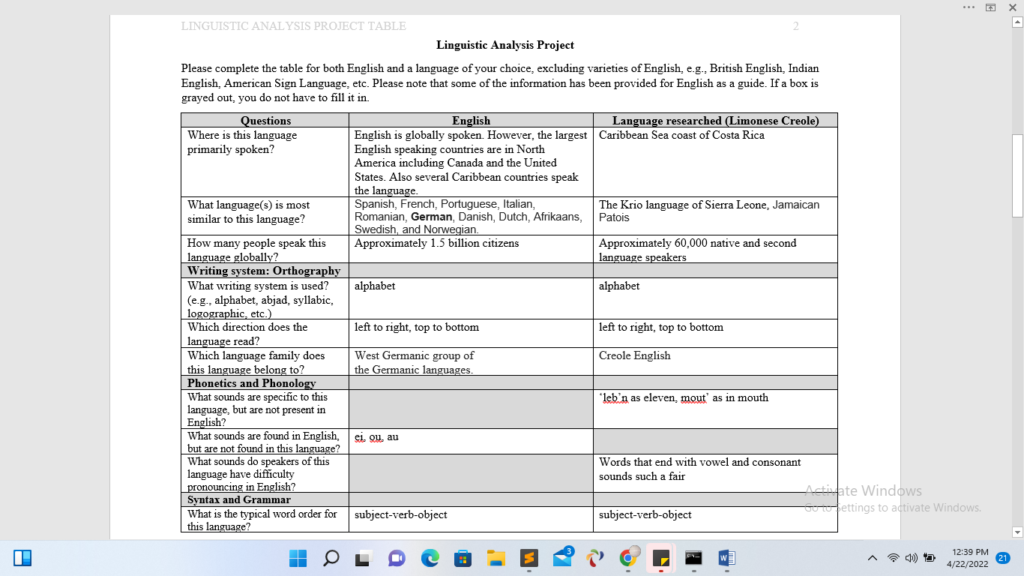
After reading the above please open file attached to develop assignment. Make sure you use the temple provided.– Linguistic Analysis Project
Please complete the table for both English and a language of your choice, excluding varieties of English, e.g., British English, Indian English, American Sign Language, etc. Please note that some of the information has been provided for English as a guide. If a box is grayed out, you do not have to fill it in.
SAMPLE SOLUTION

Order Original and Plagiarism-free Papers Written from Scratch: